Skip to content
Pinel DAHOUI
Studies · Applied research

From African public data to decisions

Research papers on major economic and health questions in West Africa, built like scientific publications and based on public data. Code and data are shared on request. The papers are written in French.

published studies
2
pages of analysis
54
studies announced
5

Published studies

Finance and economics · Public health

Cover page of the paper “Savings groups, mobile money and credit risk: what bank histories miss”
Inclusive finance

Savings groups, mobile money and credit risk: what bank histories miss

October 2026 · 30 pages · PDF

Many adults save in a rotating savings group without ever having had a bank loan. Do these behaviours carry information on default risk? Using Kenya’s 2024 FinAccess survey, we show that active savings-group members repay more reliably and that this information modestly improves default prediction. Global Findex microdata then measure the population concerned in WAEMU.

default rate among borrowers who save in a group / among others
11.6% / 18.0%
lower odds of default for a member who saves and borrows in the group
−49%
WAEMU adults save in a group without formal borrowing
21.3 M
Data and methods
Data :
FinAccess 2024 (Kenya: 20,871 adults, including 13,095 borrowers); World Bank, Global Findex 2025 (7 WAEMU countries, 7,002 adults).
Methods :
Survey-weighted logistic regressions, gradient boosting, cluster cross-validation, Shapley values (R, Python).
Cover page of the paper “Malaria in WAEMU: progress is running out of steam”
Malaria

Malaria in WAEMU: progress is running out of steam

October 2026 · 24 pages · PDF

With 1.8% of the world’s population, WAEMU accounts for 15% of global malaria deaths. We show that the decline continues, but more slowly since 2015 and far from the pace required by WHO milestones: no member state is on track. Insecticide-treated nets go hand in hand with lower mortality, much less with fewer cases.

of global malaria deaths in 2024
15.2%
mortality per year since 2015 (−4.8% per year before)
−3.7%
states on track for the WHO 2025 milestone
0 of 8
Data and methods
Data :
WHO Global Health Observatory (World Malaria Report 2025 estimates) and World Bank; 8 WAEMU states, 45 sub-Saharan African countries, 2000-2024.
Methods :
Weighted aggregates, trend-break models, two-way fixed-effects panel, Driscoll-Kraay standard errors (R, Python).

Coming soon

More studies will join this page soon. Subscribe to the newsletter to be notified of each new release.

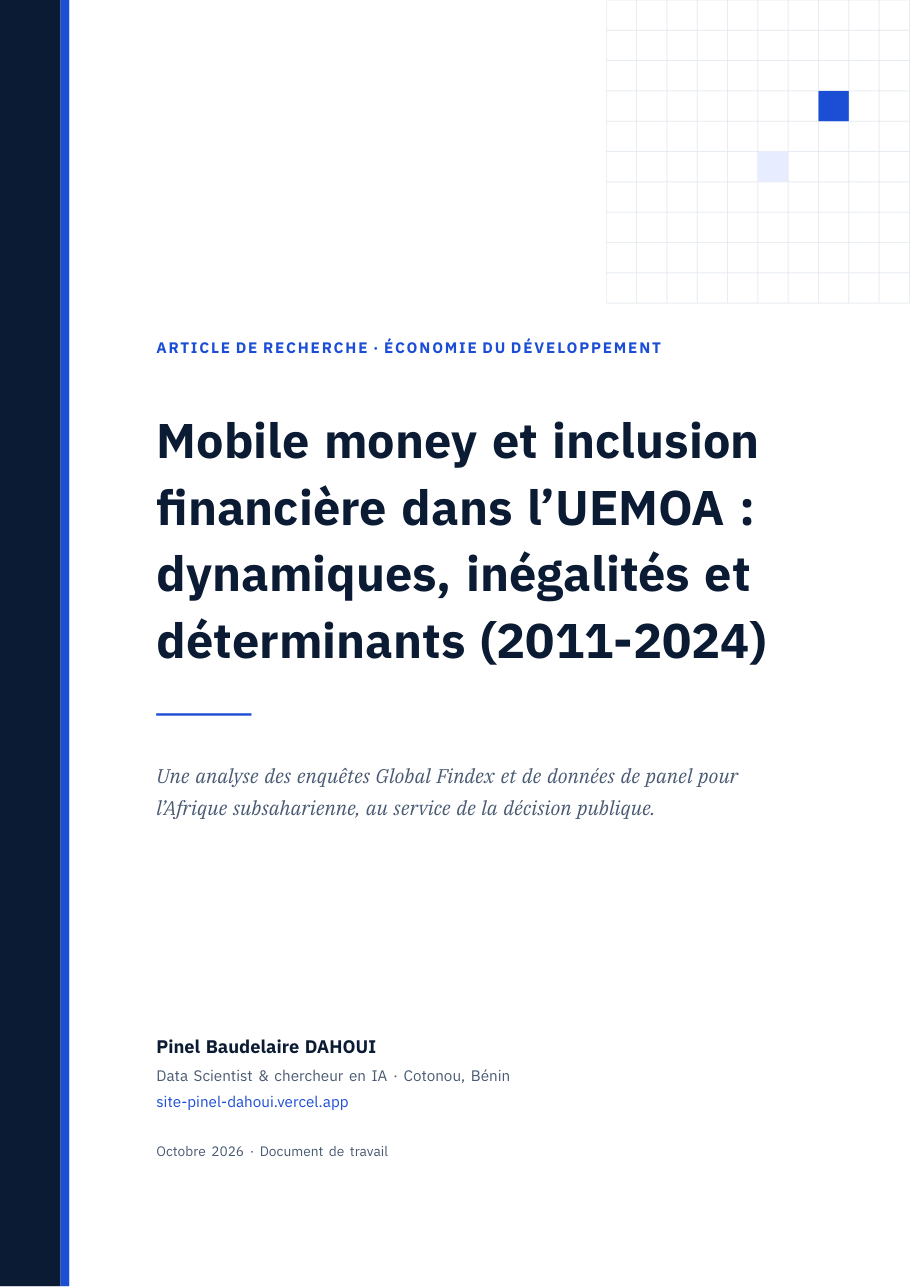
  • Cover page of the paper “Mobile money and financial inclusion in WAEMU: dynamics, inequalities and determinants (2011-2024)”
    Coming soonFinancial inclusion

    Mobile money has transformed access to financial services in West Africa. But who really benefits, and who is left behind? Fifteen years of data on WAEMU countries to find out.

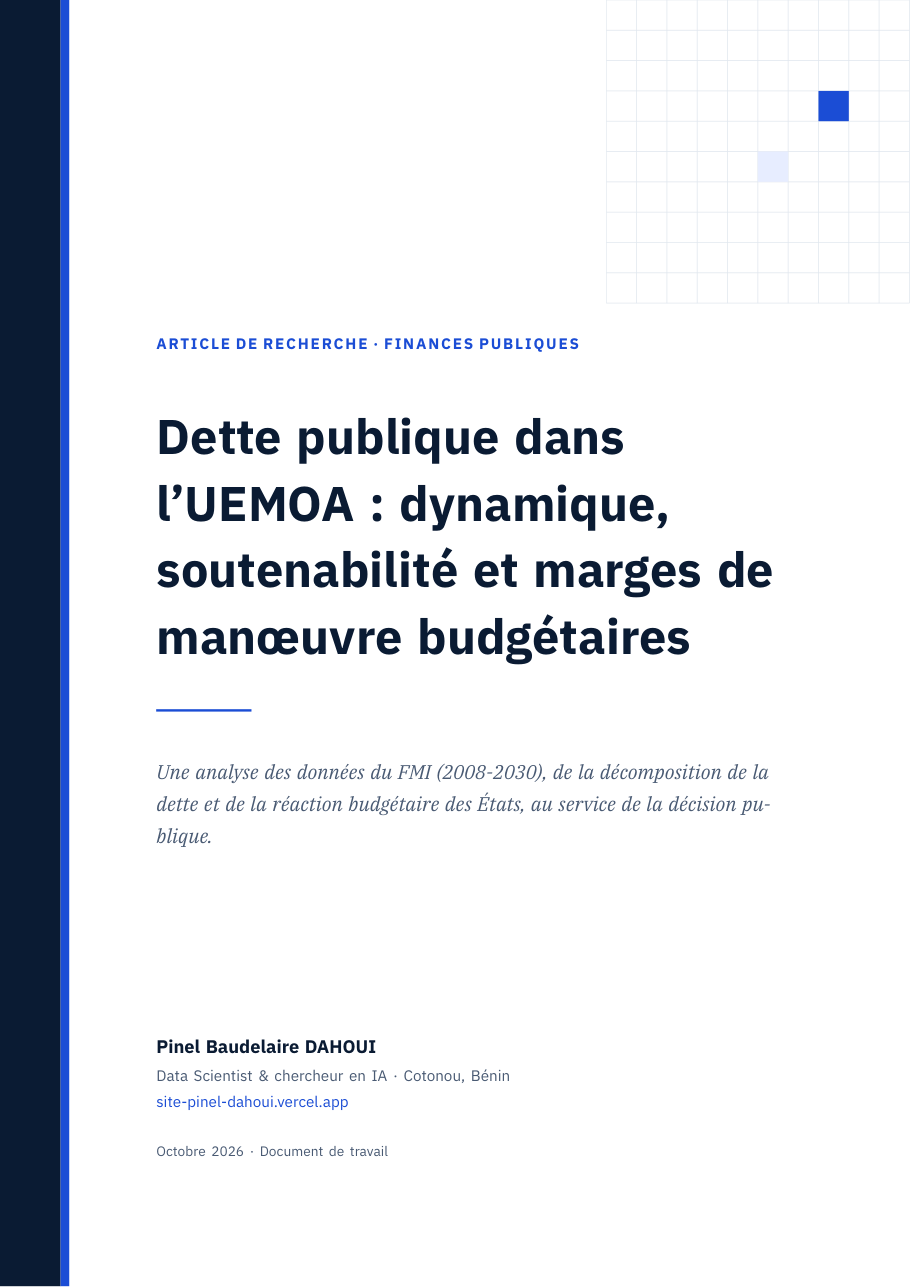
  • Cover page of the paper “Public debt in WAEMU: dynamics, sustainability and fiscal space”
    Coming soonPublic finance

    Public debt in WAEMU states has risen sharply in a decade. Should we worry? Where does the increase come from, and what does it cost national budgets?

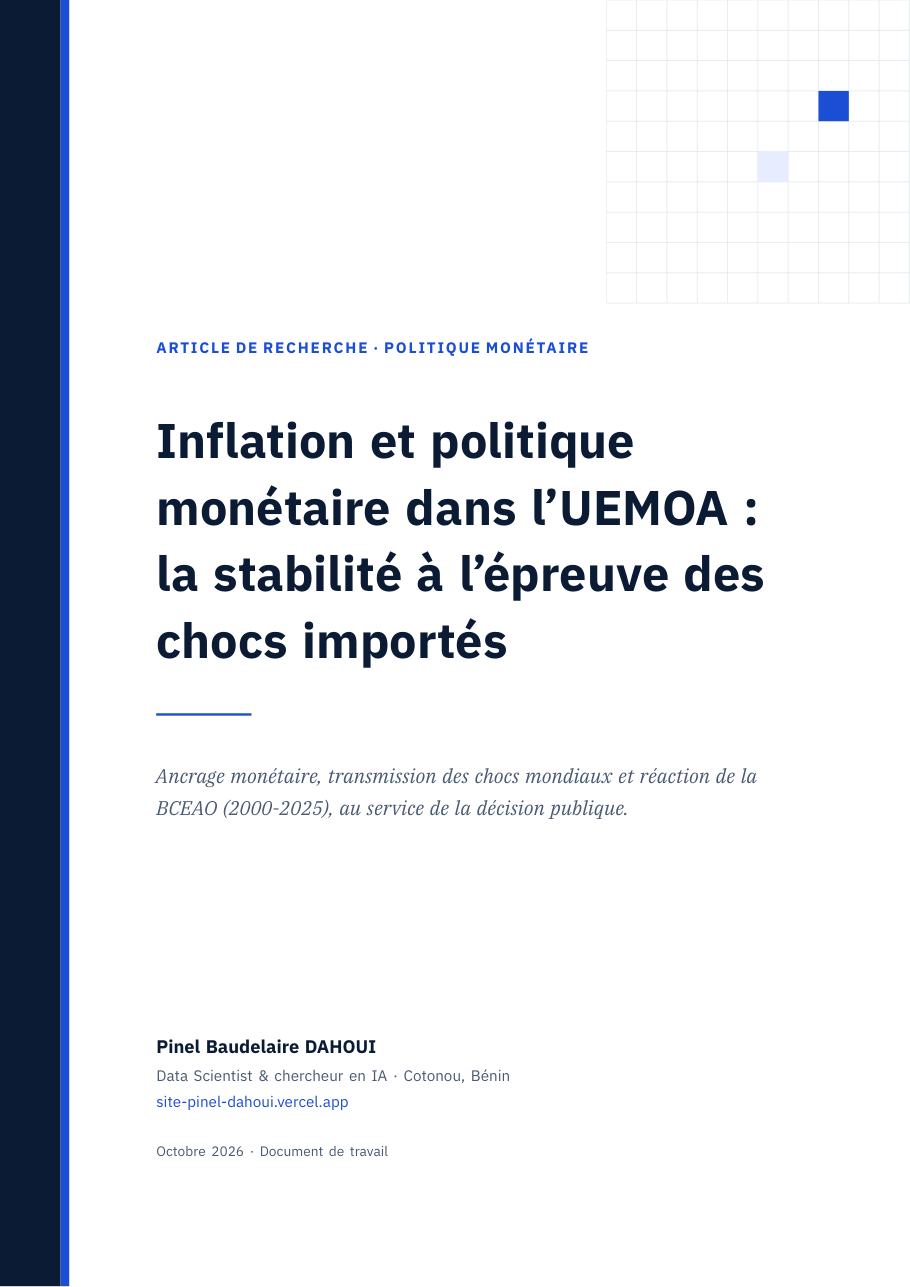
  • Cover page of the paper “Inflation and monetary policy in WAEMU: stability tested by imported shocks”
    Coming soonMonetary policy

    Does the CFA franc really protect against inflation? A look back at the 2022 price surge and the BCEAO’s response, compared with neighbouring countries.

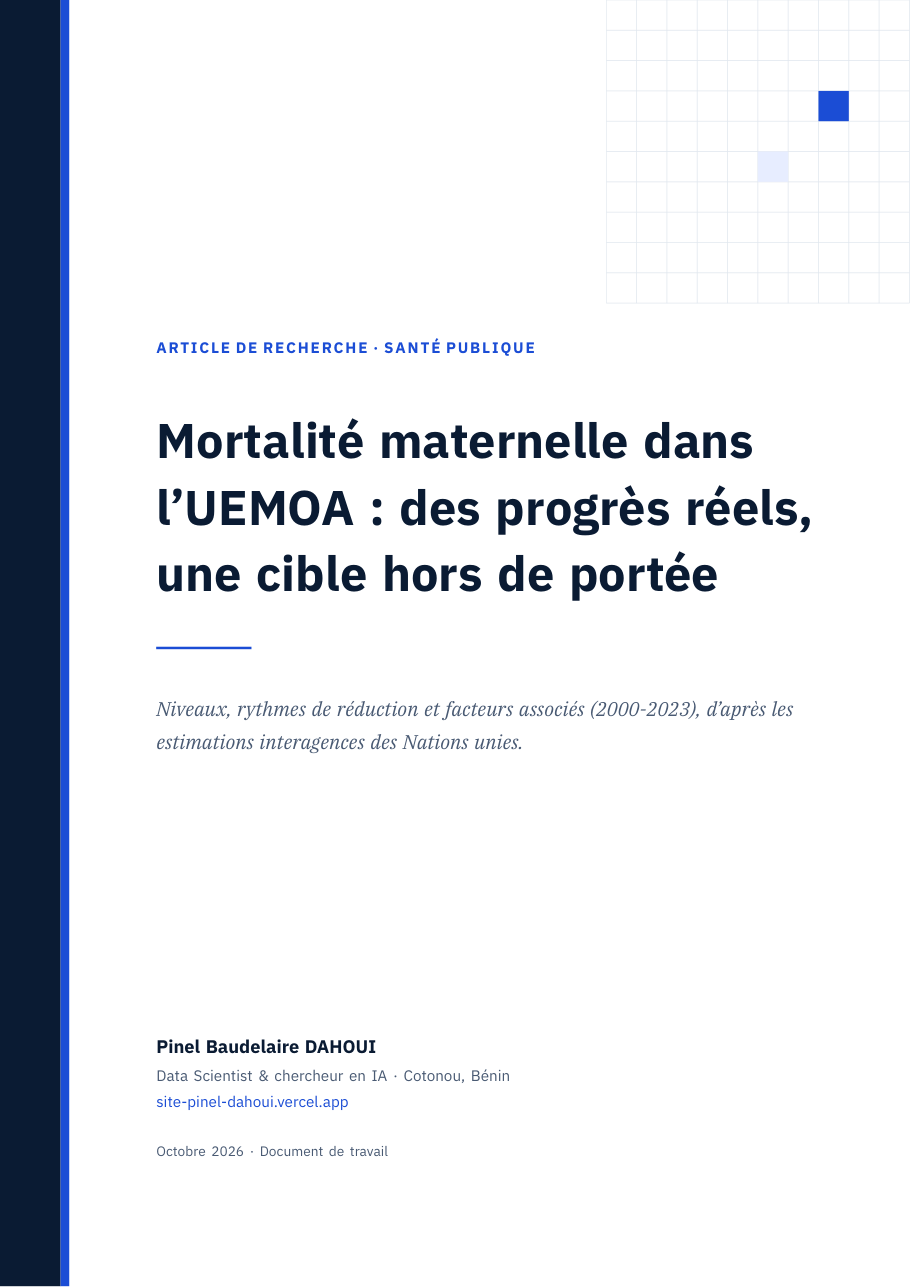
  • Cover page of the paper “Maternal mortality in WAEMU: real progress, an out-of-reach target”
    Coming soonMaternal health

    Giving birth remains a very real risk in the Union. Will the progress of the past twenty years be enough to reach the 2030 target?

  • Cover page of the paper “Electricity and the digital divide in WAEMU: two gaps that go hand in hand”
    Coming soonEnergy and digital

    Tens of millions of people in WAEMU still live without electricity, and often without the internet. Are the two gaps moving at the same pace?

Be notified of every new study

One email per release, with the key findings and a link to the paper. No spam, unsubscribe in one click.

Our approach

Public, traceable data

World Bank, IMF, WHO, BCEAO: official public sources, cited with their access date.

Rigorous methods

Panel data econometrics, robustness checks and appropriate standard errors, in R and Python.

Verified references

Every bibliographic reference is checked at the source; every figure in the text is produced by the code.

Concrete recommendations

A policy brief and a recommendations table with monitoring indicators.

The papers are working papers. To cite: Dahoui, P. B. (2026), paper title, working paper, Cotonou. The Python and R code and the data are shared upon a reasoned request by email.

A study on your own data?

Institutions, NGOs, companies, researchers: I carry out complete statistical and econometric studies, from data collection to the final report.

Describe my project